Guest Speaker Robyn Delk, Web Developer, ASP

Guest Speaker Robyn Delk, Web Developer, ASP

ASP - Associated Systems Professionals

At our most recent WV Coding Club meeting we had great insights from a Web Developer at Associated Systems Professionals (ASP), Robyn Delk. She has worked for ASP for over four and a half years, but has been in web development for over 17 years. Robyn shared she was originally from Idaho, but moved to West Virginia. She did not have a straight path into Coding, Web Development, and UX/UI (User Experience / User Interface).


Her first exposure to computers was in Kindergarten with an Apple IIc computer where she used a program that allowed her to make decisions, which she found fascinating. Her fascination came when she could press some arrows on the keyboard and watch the computer respond to her responses. She shared that her Dad was also like that, an electrician, who would put wires together to get a desired outcome.


After high school Robyn went into the military, which also brought her to West Virginia. She has four children and when they were young, she was pursuing her Software Engineering degree. She was learning Java and had lots of challenges while also raising young children. Robyn seemed to hit a "brick wall" in completing one of her classes. She was upset and felt defeated, but she stuck with it and in the end was successful. It was very rewarding for her.


She attended Colorado Technical University, where she earned a Bachelor of Science Information Technology in Software Engineering, but it doesn’t directly apply to what she currently does for work. She describes that she stumbled into a Web Developer role when she saw a job posting looking for a year experience with a go getter attitude. Education provided a good foundation, but much was learned on the job. As part of her education, she completed a capstone project and developed a portfolio of work for interviews.


At her current job Robyn does Front-end Web Development and UX/UI (User Experience / User Interface) design.

She primarily uses HTML, CSS, some JavaScript, and jQuery in her work. Robyn is able to work from home, but her job didn't start out that way. However, she works in a team-oriented environment that is very beneficial to completing projects.


If you're a Web Developer, you can work on front-end, back-end, or both.

1. Front-end is what people see

2. Back-end is what people don’t see, data from outside sources, payment processors or databases


Advice from Robyn:

1. When you have a problem giving you fits, problem solving skills go a long way. 

2. Use the "20 minute rule", look first yourself for resources, then ask for help. You can ask teammates or participate in online forums. No one should ever feel embarrassed to ask questions; you’ll never know it all. Collaboration is key.

3. Be curious, break it, learn.

4. When interviewing, your ability to collaborate is a key skill.

5. Coding is not for the faint of heart, but it isn't hard, it just requires perseverance. Don’t give up on yourself!

6.  Go to school, learn all you can, but experience increases ability for compensation.

7. Once you learn logic and a coding language, then learning other languages becomes easier. At that point, it’s just a matter of learning the syntax.


With all the types of devices that can display a website, she helps to ensure that what she builds is a "responsive" website, which must be paid attention to when writing code. Many websites are built inside of a Content Management System (CMS) which helps to manage much of the website’s basic components, but developers should still know how to build websites outside of these systems.

In her current role, she doesn’t really use Artificial Intelligence (AI), yet, but it can be utilized to assist.


ASP is based in Charleston, West Virginia and is a Managed IT Services, Application Development, and Web Design Company, operating since 2004. They now support companies in practically every industry to include governmental agencies. They compete with out of state groups in their work, and several firms that do similar work in WV, so it is challenging, and they must stand out in a special way. Sometimes winning a project comes down to price and sometimes reputation. If you do great work and you provide great service, clients like that and will continue to work with you.


Robyn was asked how do you compete with AI for building websites?

There are a lot of things AI cannot do. AI does not know a company’s goals or recognize fully the needs of their project.  It does not know how to prioritize what is important.  It is still easy to make a living even with AI's potential.


How often do you use jQuery?

Daily either reading or writing it. jQuery is very embedded into the web development world.  There are several languages and frameworks that can be used in web development and application development. Some of these we see frequently are Python, PHP, C# (C Sharp), and .NET.


Dan McElroy, President of the WV Coding Club said, "Thank you Robyn for your insights and sharing your story. It is great to see people and companies in West Virginia doing great  in the IT industry. Our students learned a lot from your talk.”

 Thank you, Robyn!

Keep coding!!
 

Guest Speaker: Arianna Ford, Programmer, West Virginia DEP

Guest Speaker Arianna Ford, Programmer at West Virginia Department of Environmental Protection

The West Virginia Coding Club started their Labor Day weekend off with a wonderful speaker, Arianna Ford. Arianna attended Lincoln County High School in West Virginia and pondered what her future career may be. Having enjoyed research through her schooling she decided to list out and apply metrics to all her potential future careers to determine her path forward. 

She had to make this choice during a challenging time in our world, the COVID Global Pandemic, a time of much uncertainty. She wanted a career where she would be happy in her work life and allow her to also be happy in her home life. Once the research was completed, she found that becoming a coder / programmer checked every box and was the path to seek in education and for her career.

Once Arianna chose that direction, another question she encountered was how much education was needed to pursue her career choice, when she hadn't really had coding experience previously. She focused on an Associates Degree at BridgeValley Community and Technical College here in West Virginia. Her beginning was challenging, not having that previous preparation which ultimately brought her to a crossroads. At that point she renewed her commitment and decided to give it everything she had towards earning her degree. During college, she learned Python, C Sharp, and SQL.

After graduating, Arianna decided to seek out job opportunities and if not successful after a year she would go back to earn her Bachelor's degree. However, in a short time she found an opportunity at the West Virginia Department of Environmental Protection and has been there almost a year and loves it. She works with Powerbuilder, JavaScript, and SQL. 

She works on a variety of programming efforts, helping to fix bugs, develop forms and primarily works individually but is part of a larger programming group. The most challenging aspect is the communication of understanding what staff want and then trying to understand what can be done within the construct of the programs.

Arianna's Advice to the WV Coding Club Students:

Do what makes you happy! If you aren't happy, then why are you doing it?

Try your hardest! If you want it, then why wouldn't you give it your all?

Ask for help, if you need it. Don't be afraid or too proud to ask for help.


President of the West Virginia Coding Club, Dan McElroy said, “We are thankful for Arianna’s time and insights for our West Virginia Coding Club students. Her enthusiasm and story help our students understand why they are learning about coding and the opportunity for the future. We particularly appreciate her comment that she wished that she had had this program when she was in high school.”

Thank you Arianna!

Keep Coding!

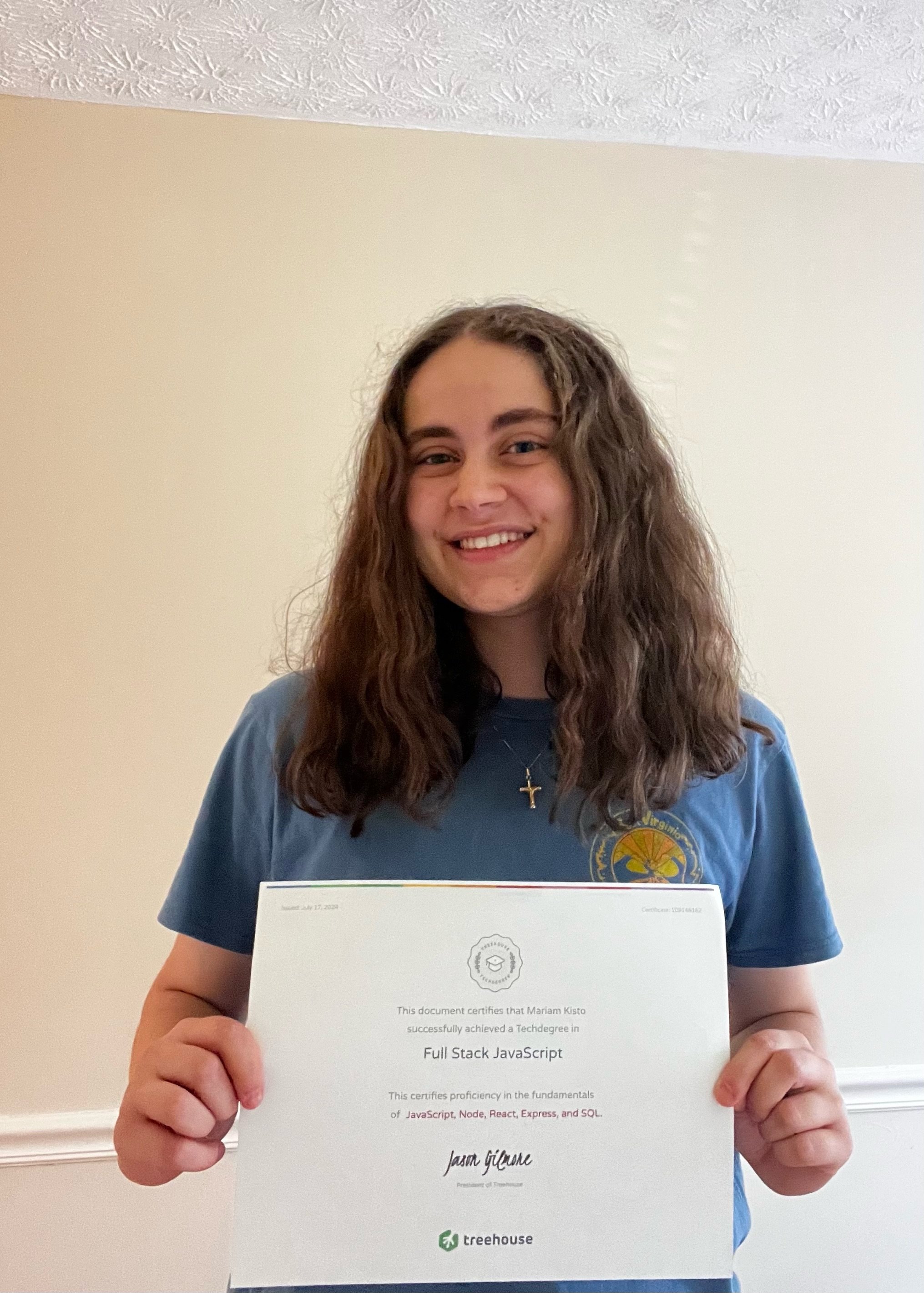
Congratulations Mariam! Stellar Achievement with Advanced Tech Degree!

Mariam Kisto - earning Advanced Tech Degree in Full Stack JacaScript

Mariam Kisto, a recent graduate of George Washington High School in Charleston, West Virginia, and a member of the West Virginia Coding Club is the first female student in West Virginia to have earned an Advanced Tech Degree Certification in Full Stack Java Script! 

Mariam has also been a team member on our Championship Congressional App Challenge Team for multiple years. Her success is a testament to Mariam’s consistent effort and dedication through the opportunity provided by the West Virginia Coding Club and Treehouse.

Mariam is no stranger to awards for her efforts, but this certification is industry-wide recognized as she pursues her career in Programming/Tech. She plans to attend Penn State University in the Fall to continue her pursuit of education in coding and computer science.

Dan McElroy, President of the WV Coding Club, shared, “We are very excited and proud of Mariam’s amazing accomplishment! She has worked hard to achieve this Advanced Tech Degree. Congratualtions Mariam!”

Guest Speaker: Joseph Miller, Software Deputy Manager, Smithsonian Institution

Guest Speaker Joseph Miller, Software Deputy Manager, Smithsonian Institution

The West Virginia Coding Club was recently fortunate to have such a distinguished guest speaker, who has been directly involved in software development with the Chandra X-Ray Observatory (https://chandra.harvard.edu/ and  https://www.cfa.harvard.edu/facilities-technology/telescopes-instruments/chandra) and other Astronomy projects connected with the Smithsonian Institution.

Joe has spent almost 25 years working for the Smithsonian Institution with the Smithsonian Astrophysical Observatory (SAO), starting as a Software Developer and progressing to a Senior Software Engineer to Lead Software Engineer then to Software Deputy Manager. He leads a team of software developers working to design, develop and implement astronomical software in support of the Chandra mission and other Astronomy projects. The team works to develop and maintain Chandra data pipelines and tools associated with Chandra’s data analysis system.

The Smithsonian Astrophysical Observatory (SAO), (https://www.si.edu/about/astrophysical-observatory) founded in 1890, is a research center of the Smithsonian Institution with the mission to advance our knowledge and understanding of the universe through research and education in astronomy and astrophysics. Affiliated with the Harvard College Observatory, SAO created the world’s first satellite-tracking network, establishing the organization as a pioneer in space science research. In 1973, the Smithsonian and Harvard created the joint Center for Astrophysics | Harvard & Smithsonian. Key areas of research include exoplanets, the sun and solar weather, asteroids and comets, and "The Extreme Universe" that includes the study of black holes, pulsars, supernovae, white dwarfs, neutron stars, and magnetars.

Joe had his first experience with computers and video games in middle school. He learned Basic and Pascal developing simple to more sophisticated programs eventually incorporating physics and related mathematics into his programs. He wanted to be a Veterinarian until he took a biology class. Then his focus changed.

He went on to college at Clarkson University to earn a Bachelor’s degree in Mathematics and Computer Science. After that he got married, and started his family.

After some time with the Smithsonian Institution, he continued his education and earned a Master’s degree in Computer Science from Worcester Polytechnic Institute.

Joe was asked about items that are good qualities for potential new employees. He shared the following:

  1. Enthusiastic - wants to learn and be involved

  2. Background Talent - projects, teamwork, able to pair program

  3. Technical Experience - understands programming language(s) and various concepts

  4. Adaptable - things change - adapt to solve problems

Joe’s advice for the students:

  1. Be prepared for the boom in Artificial Intelligence, there will be great need in that area.

  2. Find something you like and try difference things.

  3. Learn different languages and constructs.

President of the West Virginia Coding Club, Dan McElroy said, “We are grateful for Joe’s time and insights for our West Virginia Coding Club students. His talk helped us to  understand the incredible impact Joe and his team’s work have on furthering knowledge about our Universe through programing and software. Thank you Joe!”

Keep Coding!

Proud Parent of WV Coding Club Student

Message from proud parent of Coding Club student William Matheny, Ripley HS:

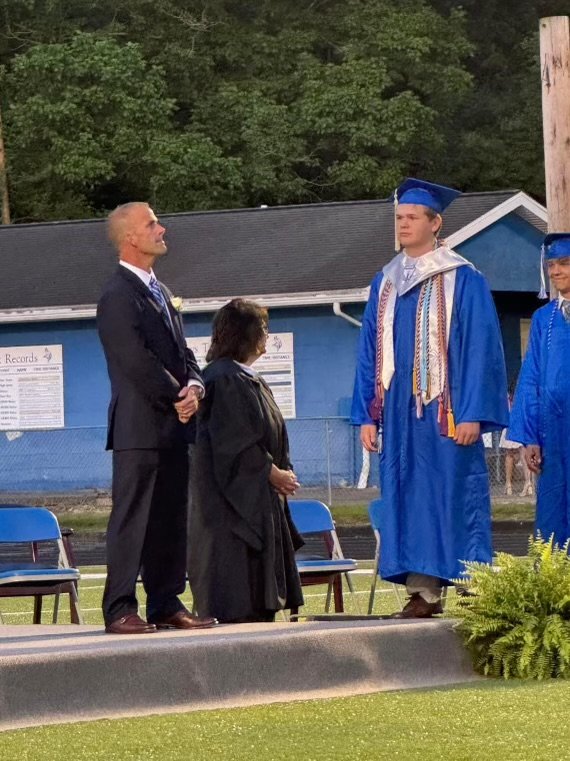
Good morning! Again, I want to thank you for investing in William over the years. He graduated with multiple honors (magna cum laude and more) and multiple scholarships this Friday. He will be attending WVU in the Fall studying computer science and minoring in cyber security. Your investment in him opened up so many opportunities and possibilities for his future. But his graduation day was made even brighter by receiving an official offer to intern with NASA once again this Summer. Thank you for the West Virginia Coding Club!

Networking Skills in Tech - Guest Speaker: Shannon Bisceglia, Treehouse

Shannon Bisceglia, Client Success Manager for Treehouse, wrapped up this series providing Networking Skills development insights this week with an emphasis of the various topics reviewed over these last few months.

Shannon explored Networking Skills in Tech to help crystalize for students the skills that may be most helpful to their development and future careers.

Coding experience is not just a skill; it is a key that unlocks countless opportunities in the tech industry, where innovation and creativity are celebrated.

NETWORKING SKILLS (THE HUMAN KIND):

1. Most people don’t think about networking (the human kind) until they are already applying and interviewing for jobs, but the sooner you start with these basic networking initiatives, the better.

2. The items covered today are “soft skills” that you can start using now! Feel free to think about examples of how you have implemented any of the skills covered in this series and refer back to previous blog posts for more details in each of these developmental skills.

WHAT CAN YOU DO NOW TO BOOST YOUR VALUE?

1. Build Social Capital

2. Seek Mentorship and Feedback

3. Start a Blog

4. Set S.M.A.R.T. Goals

5. Project Management

6. Customer Support

SOCIAL CAPITAL

What is Social Capital and How Can You Develop It?

a. Social Capital is the value that comes from your connections with others

b. Your close relationships are your most valuable asset. They will most likely open doors in your future.

You need to invest in your relationships! How can you do that now?

1. Write Thank You Notes!

2. Be Genuinely Interested!

3. Do What You Say You Are Going To Do and Do It On Time!

FEEDBACK AND MENTORSHIP

How to give and receive feedback:

1. Feedback helps us understand our strengths and weaknesses.

2. It provides insight into blind spots we might not see ourselves.

3. It guides us towards improvement and excellence.

4. Acting on feedback can signal your value to potential mentors.

THINGS TO CONSDIER WHEN GIVING FEEDBACK

Keep these four points in mind:

1. Be specific: Instead of “good job”, say, “I appreciate how you clearly explained your ideas.”

2. Be timely: Feedback is most effective when given close to the event.

3. Be constructive: Offer suggestions for improvement, not just criticism.

4. Be empathetic: Consider the person’s feelings and perspective.

ACTING ON FEEDBACK CAN LEAD TO MENTORSHIP

What is a Mentor?

1. A mentor is someone who guides and supports you in your personal and professional growth.

2. Mentors can offer valuable advice, share experiences, and provide encouragement.

3. When you are open to feedback, people notice your willingness to learn and grow.

4. Those who give you feedback might become potential mentors.

5. Mentors want to help individuals who show a desire to improve.

6. Show gratitude: If someone gives you valuable feedback, express your appreciation.

7. Be open: Be open to learning from various sources, and trying new things.

START A BLOG

Blogs allow you to:

1. Demonstrate initiative and responsibility

2. Build a Portfolio

3. Develop critical writing skills

4. Demonstrate skills and abilities with zero or minimal work experience

Staying consistent is the most important aspect of this effort. Choose a workflow that fits your life and stick with it.

SET S.M.A.R.T. GOALS:

How can you master the art of setting S.M.A.R.T. Goals?

S.M.A.R.T. stands for Specific, Measurable, Achievable, Relevent, and Time-bound.

1. Specific: Clearly define what you want to achieve.

2. Measurable: Make sure your goal can be tracked and measured.

3. Achievable: Set goals that are realistic and within your reach.

4. Relevant: Make sure your goal matters to you and aligns with your values.

5. Time-bound: Set a deadline to keep yourself accountable.

EXAMPLES OF S.M.A.R.T. GOALS:

1. Academic: “I will improve my Algebra grade from a B to an A by the end of the semester by attending tutoring sessions twice a week and completing all homework assignments.”

2. Personal Development: “I will learn to play the guitar by practicing for at least 30 minutes every day and taking weekly lessons for six months."

HOW TO CRAFT S.M.A.R.T. GOALS:

Things to consider:

  1. Identify what you want to achieve: What are your dreams and aspirations?

  2. Make it specific: What exactly do you want to accomplish? Do you need to break a larger goal down into smaller steps?

  3. Ensure it is measurable: How will you track your progress?

  4. Make it achievable: Is your goal realistic given your resources and constraints?

  5. Ensure it is relevant: Why is this goal important to you?

  6. Make it time-bound: When do you want to achieve this goal by?

Embrace the journey ahead, stay curious, and continue to expand your horizons in the ever-evolving world of technology!

Keeping a focus on these Networking Skills helps to guide you to new experiences and education to develop your skills and knowledge to become successful in whatever path you choose.

Dan McElroy, President of WV Coding Club, shared, “What an amazing series of topics and insights for our West Virginia Coding Club students! Thank you Shannon for these great sessions and useful skills to develop!"

Treehouse's mission is to diversify the tech industry through accessible education, unlocking the door to opportunity, and empowering people to achieve their dreams. Offering courses to individual learners, internal company teams, and third-party education providers, Treehouse helps to bridge the gap between formal educational institutions and on-the-job requirements.

Thank you Shannon!

To learn more about Treehouse, click the link: www.teamtreehouse.com

Keep Coding!